Compare
Free shipping
Best price guarantee
SimpleCrew exclusive savings
0% APR Financing
Tire replacement coverage
24/7 roadside assistance
Easy returns
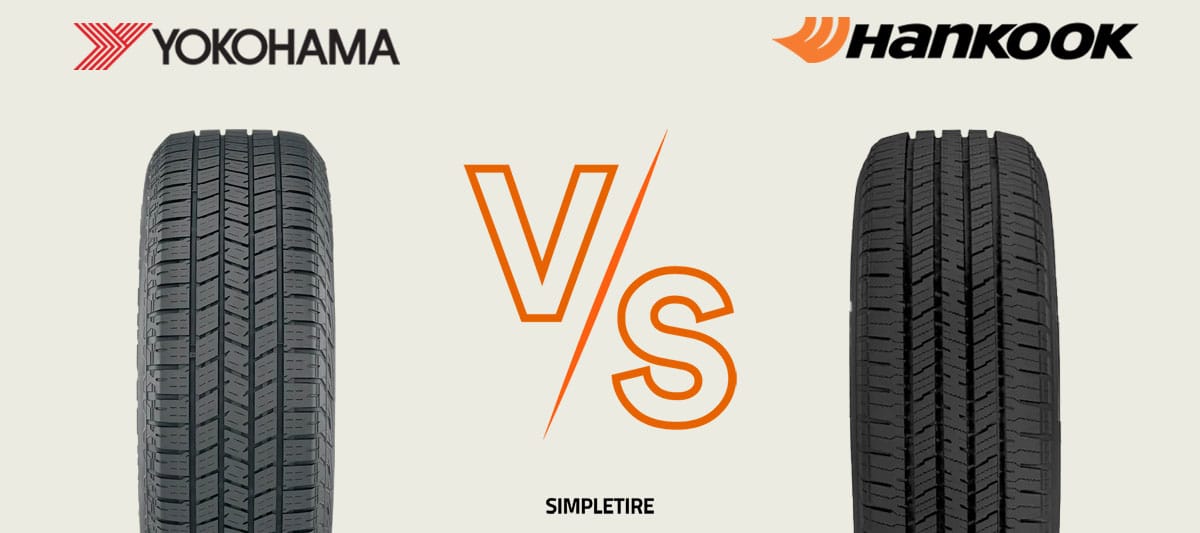
Highway terrain tires demand reinforced construction and a solid sidewall design, along with a special rubber compound that can keep them going in various driving conditions, like dry, wet, and light snow. Yokohama and Hankook are two prominent names when it comes to manufacturing quality tires for SUVs and pickup trucks. Both brands have been exceptional in delivering great value to drivers who bank on their tires.
Their famous tire families – Geolandar from Yokohama and Dynapro from Hankook – have been on the market for a while and are loved for their impeccable performance in changing weather and terrain conditions. The latest Geolandar to hit the market is the H/T4, which takes on the existing Hankook Dynapro HT (RH12). Both tires promise to deliver what highway drivers crave most: dependable year-round traction, great ride comfort, and long-lasting tread life.
The Yokohama Geolandar H/T4 represents a modern evolution in highway performance, placing a strong emphasis on enhanced wet grip and the latest compound technology that adapts beautifully to changing seasonal conditions. On the other hand, the Hankook Dynapro HT (RH12) is a time-tested favorite known for its incredibly stable footprint, low rolling resistance, and smooth, quiet ride on long commutes.
So, which one makes more sense? Let’s compare the two in this Yokohama Geolandar H/T4 vs Hankook Dynapro HT (RH12) tires comparison based on their performance in our SimpleScore, which rates each tire on a scale of 0 to 10 for traction, handling, and longevity traits. SimpleScore is our in-house scoring mechanism that evaluates the aforementioned characteristics of a tire and helps in making a wise decision. Read on.
Last updated 6/05/2026 - Originally published 6/05/2026
Written by SimpleTire, Expertly reviewed by Brett Antosh
Yokohama Geolandar H/T4 tires

Debuting in April 2026, the Yokohama Geolandar H/T4 is specifically formulated to withstand high torque demands while ensuring a smooth and stable ride quality on highways. Thanks to the robust Endurocore Construction, the LT-metric sizes of the Yokohama tire significantly boost load capacity for severe towing and hauling.
The use of four wide circumferential channels means quick outflow of water, whereas interlocking triple 3D sipes improve steering precision and promote uniform wear while preventing tread squirm. The computer-tuned tread design of the Geolandar resists sound waves for improved cabin silence. It is covered by an up to 70,000 mile limited manufacturer tread life warranty for standard sizes and 55,000 miles for LT configurations.
Securing an 8.9 overall SimpleScore, the Yokohama Geolandar H/T4 is a highway-terrain option built for light trucks and SUVs.
Get Yokohama Geolandar H/T4 tires at the best deals for your vehicle here
Hankook Dyanpro HT (RH12) tires

Engineered for sport trucks and SUVs, the Hankook Dynapro HT (RH12) delivers great all-season performance, enhanced wearability, and reliable year-round grip. A computer-generated symmetric tread pattern maximizes comfort by muting harsh highway noise and vibrations, while its solid shoulders maintain block rigidity under heavy loads to ensure stable handling.
For wet and wintry conditions, the tire utilizes four wide circumferential grooves to fight hydroplaning, alongside independent intermediate blocks and zigzag sipes that provide extra biting edges in light snow. The Hankook tire is backed by a 70,000 mile limited manufacturer tread life warranty for P-metric sizes and a 40,000 mile warranty for LT sizes.
Achieving an 8.2 overall SimpleScore, the Hankook Dynapro HT (RH12) assures solid durability, traction, and longevity throughout the year.
Get Hankook Dynapro HT (RH12) tires at the best deals for your vehicle here
Yokohama Geolandar H/T4 vs Hankook Dyanpro HT (RH12) tires on traction
Traction is defined as the ability of a tire to hold the ground without skidding. And when you have a heavy load to carry, its significance increases manifold. The Yokohama and Hankook tires are pretty solid on this front. Let’s analyse what makes them so.
Scoring an 8.5 in traction, the Yokohama Geolandar H/T4 assures reliable grip in different driving conditions, including dry, wet, and light snow. Thanks to its dual lug grooves and large center blocks, the highway tire returns solid traction and braking capability on smooth roads. While wide circumferential grooves flush water out to mitigate hydroplaning, the Triple 3D blocks of the Yokohama tire stabilize tread blocks, leading to improved wet braking.
On the other hand, the Hankook Dyanpro HT (RH12) secures an 8.2 in traction, which means it’s a good option for drivers wanting a trustworthy year-round companion.
With a better score, the Yokohama Geolandar H/T4 wins the traction race.
Advantage: Yokohama Geolandar H/T4
Yokohama Geolandar H/T4 vs Hankook Dyanpro HT (RH12) tires on handling
Precise steering response is essential for overall control and stability of the vehicle on highways. The Geolandar H/T4 and Dynapro HT (RH12) are almost neck and neck in their handling performance.
Pulling off an 8.4 in handling, the Geolandar H/T4 provides adequate control and good steering feedback when driving at highway speeds in changing weather conditions. The Yokohama tire provides improved stability along with enhanced steering response courtesy of the rigid shoulder blocks. While the advanced rubber compound adds stability to the ride, the optimized tread design assures tire integrity is always maintained, whether driving under heavy loads or cornering.
Scoring an 8.5 in handling, the Hankook tire is marginally ahead of the Yokohama in steering feedback, stability, and on-road refinement. Thanks to its interlocking ribs and reinforced steel belts, the highway tire provides superb stability and control at highway speeds. Additionally, the deep tread depth not only improves steering performance but also boosts straight-line stability.
A win is a win even if it’s by a thin margin. The Hankook turns the tables and wins the handling race. The scores are levelled 1-1.
Advantage: Hankook Dynapro HT (RH12)
Yokohama Geolandar H/T4 vs Hankook Dyanpro HT (RH12) tires on longevity
Highway terrain tires are preferred for their refined ride quality and improved wearability. The Yokohama and Hankook tires show the starkest difference in tread life. Let’s do the longevity analysis.
Boasting an incredible 9.9 longevity score, the Yokohama highway tire ascertains year-round superior wearability along with enhanced durability. With advanced compound technology, the tire not only delivers low rolling resistance to boost fuel efficiency but also restricts irregular wear in dry, wet, and light wintry conditions. Lastly, it is backed by an excellent 70,000 mile limited manufacturer tread life warranty.
Contrarily, the Hankook tire falls behind and, despite improving its performance, manages to score an 8.6 in longevity. Thanks to its wide contact patch and symmetric tread pattern, the Dynapro HT limits uneven wear and promotes uniform wear throughout its lifespan. Backed by an up to 70,000 mile limited manufacturer tread life warranty, the reinforced internal structure with steel belts and deep tread depth provides strong durability for hauling heavy loads.
Securing an incredible score, the Yokohama Geolandar H/T4 ascertains why it’s the most preferred tire for drivers wanting a longer service life. The Hankook is way behind!
Advantage: Yokohama Geolandar H/T4
When to use each
Highway-terrain tires are designed for SUVs and light trucks that withstand heavy loads and towing responsibilities on paved roads. Their reinforced sidewalls and tough carcass allow them to work tirelessly under heavy loads for longer interstate commutes. They return excellent wearability, wet performance, and solid durability.
For drivers wanting solid grip and traction along with an exceptional tread life, the Yokohama Geolandar H/T4 is the best option, while the Hankook Dynapro HT (RH12) is tailored more towards refined ride quality with improved steering response and stability on the highway. However, none of the tires is Three Peak Mountain Snowflake certified; hence, they should not be used in severe winter weather conditions of deep ice and snow.
Which one should you choose?
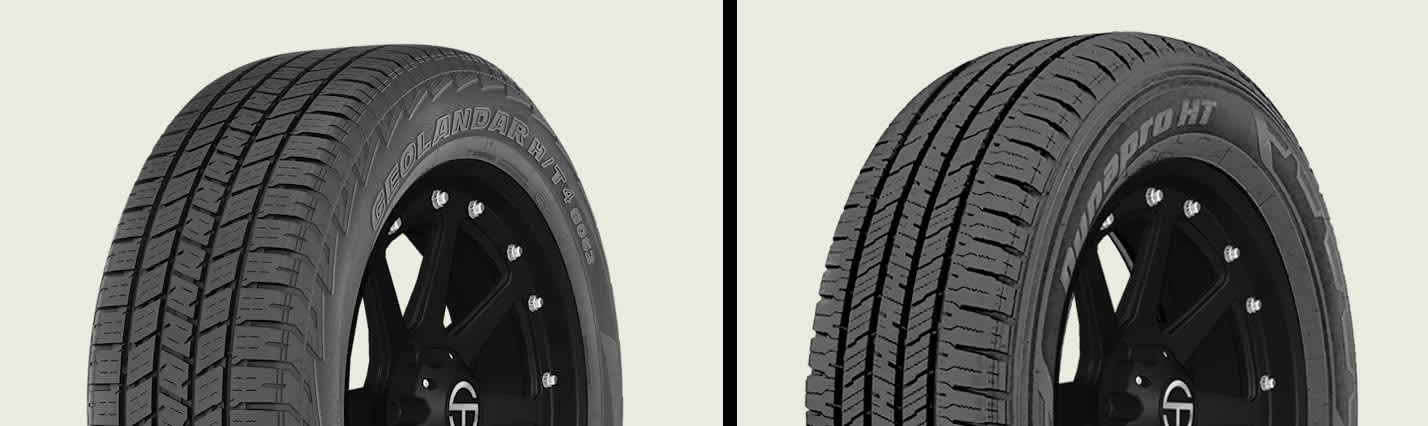
To sum it up, the Yokohama Geolandar H/T4 wins the comparison by 2-1 as it beats the Hankook in traction and longevity while losing in the handling department. Both are backed by solid mileage warranties. However, your selection should be based on your needs, budgets, and driving habits, as each tire has its own individual traits, which may suit a particular set of drivers.
Lastly, let’s go down to the final dealbreaker of the tire purchase – the price. For the 275/65R18 116H tire size, the Yokohama Geolandar H/T4 is tagged at around $222, which brings the price of four tires to about $888. On the other hand, the price of each Hankook Dynapro HT (RH12) is $246, which means four such tires would cost you approximately $984.
Based on SimpleScore, you should buy the Yokohama Geolandar H/T4 if you:
- Drive vehicles like the Honda CR-V, Ford Expedition, or Chevrolet Suburban
- Want a set of highway-terrain tires with incredible longevity (9.9 vs 8.6)
- Prefer a set of highway tires with improved traction (8.5 vs 8.2)
- Want a better warranty on LT-metric sizes (55,000 miles vs 40,000 miles)
- Want an overall better and more affordable tire
On the other hand, you may consider buying the Hankook Dynapro HT (RH12) if you:
- Drive vehicles like the Toyota Tacoma, Nissan Rogue, and Ford Transit 250
- Want improved stability due to the higher tread depth
- Prefer a highway tire with superb handling characteristics (8.5 vs 8.4)
- Are comfortable paying more
Still not sure which tire to buy? Fortunately, SimpleTire is here to help, as our helpful agents are more than happy to assist you in selecting the right tire for your ride and budget.
You may also be interested in:
Gripmax MaxGrip X/T vs Arroyo Tamarock R/T tires
MaxGrip X/T and Tamarock R/T are two of the best tire lines on the market, but which one is best for you? Let’s break it down with SimpleScore.
Written by Irfan Khan
September 30, 2026
Continental TerrainContact H/T vs Falken Wildpeak H/T02 tires
TerrainContact H/T and Wildpeak H/T02 are two of the best tire lines on the market, but which one is best for you? Let’s break it down with SimpleScore.
Written by Irfan Khan
September 30, 2026
Falken Wildpeak A/T4W vs Firestone Destination A/T2 tires
Wildpeak A/T4W and Destination A/T2 are two of the best tire lines on the market, but which one is best for you? Let’s break it down with SimpleScore.
Written by Irfan Khan
September 30, 2026
Ready to find the perfect tires?
Search By