Tire Buying Guides
All-Season Tires: Engineering, Use Cases, and Comparisons

Free shipping
Best price guarantee
SimpleCrew exclusive savings
0% financing options
Tire replacement coverage
24/7 roadside assistance
Easy returns
Tire Buying Guides
All-Season tires are designed as a "hybrid" solution, blending the heat resistance of summer tires with the light-traction capabilities of winter tires. They are the standard equipment for over 50% of vehicles in North America.
All-season tires utilize "Middle-Ground" engineering to eliminate the necessity for changing tires twice a year.
Rubber Composition:All-season tires use special silica materials. These materials stay flexible in different temperatures. This is different from summer tires, which harden in the cold. It is also different from winter tires, which can slip in the heat.
Tread Design: These tires have grooves around them to help drain water. They also have small cuts to create "biting edges" for better traction in light snow.
Noise Mitigation: Tread blocks come in different sizes to reduce road noise. This design makes the cabin quieter than with more aggressive winter tires.
To choose the right tire, it is vital to understand that "all-season" does not mean "every condition." Depending on your climate and driving style, you may need to distinguish between standard all-season rubber and more specialized alternatives.
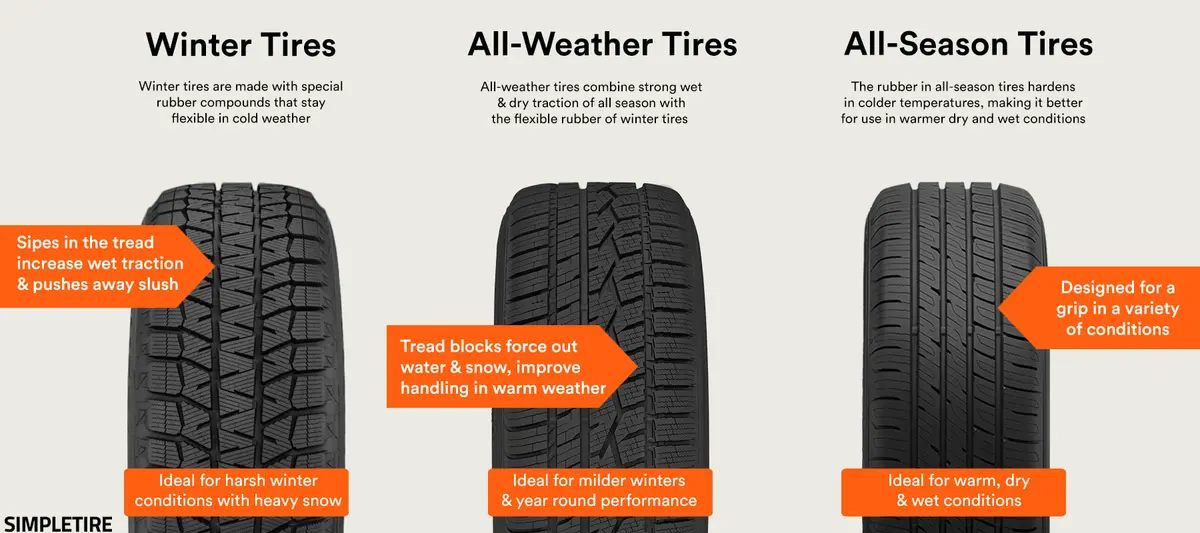
All-Season Tires (The Standard): Designed for regions with mild winters and frequent rain, these tires carry the M+S (Mud and Snow) symbol. They offer the longest tread life and best fuel economy, but their rubber begins to harden and lose traction once temperatures drop below 45°F.
Ultra-High Performance (UHP) Tires (The Specialist for Speed): Ultra-high-performance tires are engineered for enthusiasts who prioritize steering response, cornering grip, and braking power over long-term tread life. While they are available with all-season compounds, many UHP tires are "summer-only," and feature a sticky rubber compound that provides maximum contact with the road. If you drive a sports car or high-powered sedan, UHP tires help translate that horsepower to the pavement, though they typically have shorter mileage warranties than standard touring tires. For a deeper dive into how these stack up against all-season tires, see our comparison of all-season vs. UHP tires.
All-Weather Tires (The Middle Ground): All-weather tires are a hybrid category that stays soft in freezing temperatures while remaining durable enough for summer use. Unlike standard all-season tires, these carry the 3PMSF (Three-Peak Mountain Snowflake) icon, certifying them for severe snow service. They are the ideal "set-it-and-forget-it" solution for drivers who face unpredictable winter weather but don't want to swap tires twice a year.
Winter Tires (The Specialist for Ice): When conditions involve deep ice, unplowed snow, or consistent sub-zero temperatures, winter tires are unrivaled. They feature an aggressive "void ratio" and deep siping to bite into frozen surfaces. However, they have the lowest longevity if driven in the summer, as warm pavement will quickly wear down their specialized soft rubber.
Key Distinction: Choosing between these categories depends entirely on your local "worst-case" weather and how much you value performance vs. longevity. You can explore the technical differences in our guide to winter vs. all-weather vs. all-season tires.
Because all-season tires are kept on the vehicle year-round, they are more susceptible to wear-and-tear issues:
All-season tires are the ultimate "jack-of-all-trades" for drivers in mild-to-moderate climates. However, they are not "no-season" tires; their performance drops significantly in deep ice or extreme heat.
Search By